
Bright Start for Healthy Futures: Building Trust, Knowledge, and Community for Better Health

Updated: Apr 14
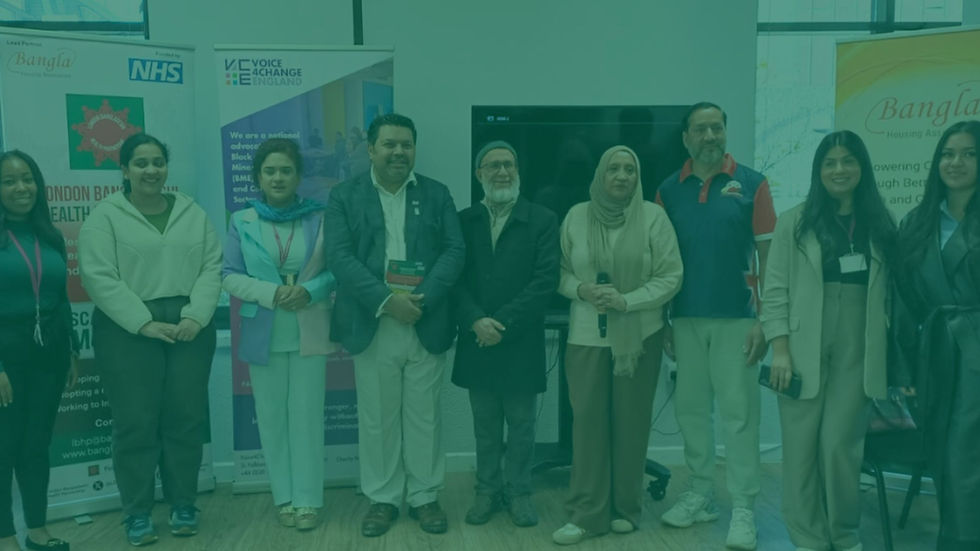
On Thursday, 26 March 2026, 25 community representatives and Bangladeshi parents, and 18 system leaders came together for 'Bright Start for Healthy Futures', a dynamic event exploring how trust, collaboration and culturally rooted health communication can improve vaccination uptake and health outcomes in London's Bangladeshi community. Hosted by the London Bangladeshi Health Partnership (LBHP) and Bangla Housing Association (BHA), and supported by Voice4Change England (V4CE), RIVER EU and the London School of Hygiene and Tropical Medicine (LSHTM), the event encouraged meaningful discussion, sharing of evidence, and practical solutions to improve community health engagement.
Welcoming the Community
The event opened with warm greetings from Dr Sharmin Shajahan, Deputy Director of V4CE and Co-Chair of LBHP, who wished attendees a Happy Bangladeshi Independence Day before introducing the LBHP Senior Management Team. Her message set the tone for a morning focused on community unity, knowledge sharing, and empowerment.
Evidence and Insights: Understanding What Works
Ifra Ali, Doctoral Research Fellow at the University of Warwick, presented findings from her team's study: "It was just the given thing to do" - Exploring Enablers for High Childhood Vaccination Uptake in East London's Bangladeshi Community. The research was supported by Professor Sandra Mounier-Jack and Dr Sadie Bell of LSHTM. The findings demonstrated why childhood vaccine uptake is higher in the Bangladeshi community in East London compared to communities with similar levels of socio-economic deprivation. They showed that a tailored vaccination approach, rather than a one-size-fits-all model, was effective in fostering trust in vaccines and community health providers, while also leveraging community and trusted social networks.
Key takeaways from the research included:
Cultivating trust through tailored, patient-centered and culturally appropriate care is essential.
Community-based organisations and social networks play a vital role in maintaining high health engagement.
Service design should recognise cultural diversity and lived experiences, reshaping how vaccine hesitancy is understood and addressed.
Community Engagement in Action
Riyadul Karim, Assistant Director for Community Engagement & Vaccine/Screening Equity at NHS England (London Region) and Co-Chair of LBHP Advisory Board, outlined his 3Ts Model, Trusted Leaders, Trusted Voices, and Trusted Places, as a practical, trust-based framework for improving equitable uptake of vaccination and prevention services. The model has been applied across diverse London communities.
The 3Ts model is both adaptable and scalable, effective in hyperlocal community settings and in structured, multi-sector forums - strengthening trust, improving access, and enabling more culturally competent, community-led health engagement.
Voices from the Tables:
Interactive table discussions allowed participants, especially parents, to share their experiences with childhood and school vaccinations.
Key themes that emerged included:
Positive experiences with school vaccination programmes and clarity around the consent process, which was facilitated by trust in schools.
Lingering hesitancy following side effects reported after COVID-19 vaccines.
A strong desire for better access to GPs and clear communication about vaccine benefits and side effects.
The need for accessible, community-based information shared by trusted individuals rather than solely through NHS websites.
Limited understanding of "catch-up clinics", with participants suggesting a more informative name could improve awareness.
Panel Discussion: Breaking Barriers, Building Trust
The panel discussion, chaired by Khasruz Zaman, Head of Community Engagement and Inclusion at Barts Health NHS Trust and Co-Chair of LBHP Advisory Board, brought together diverse voices including Dr Sharmin Shajahan, Riyadul Karim, Professor Sandra Mounier-Jack, Ifra Ali, Abbie Imakumbili (Redbridge Public Health), Elizabeth Owens (Newham Public Health), and Sumaiyah Rahman (Tower Hamlets Public Health).
The panel tackled important community questions, from tackling misinformation about vaccines and autism to improving vaccination awareness amongst older adults. They stressed the importance of simple, accessible language, community-led communication, and multi-channel outreach to ensure all families feel informed and confident in making health decisions.
A Day of Health, Learning, and New Beginnings
Participants were also invited to access free health check-ups provided by the Woodgrange Health Clinic.
The event closed with remarks from Bashir Uddin, CEO of the BHA, host organisation of LBHP. He spoke about the London Bangladeshi Women's Partnership, launched during International Women's Month, an exciting next step in LBHP's mission to strengthen community health through collaboration and empowerment.
After an enriching morning of learning and exchange, attendees continued conversations over lunch.
Read more about the application of the 3T model:
Riyadul Karim and Jacqueline Walker, "3Ts Model of Community Engagement to Tackle Vaccine Inequalities in Underserved Communities," poster presentation, Asian Professionals National Alliance (APNA) NHS Conference, Liverpool, UK, 16 October 2025.


Comments